

back to Genesis
Introduction
As before, please see the NETS Translation and the Constable’s notes commentary.
Gen. 44
Joseph’s final test of his brothers’ sincerity of repentance for what they did to him would center on Benjamin, who was just greatly honored in front of them all by being given five times as much food as his brothers at the luncheon Joseph had invited them to. Joseph tells his steward to load up the brothers with food and provisions, and to also add the silver to the sacks as before. But this time he also has his own special silver cup put into Benjamin’s sack of food, then sends the brothers on their way home.
Shortly after they leave, he tells the steward to run after them and accuse Benjamin of stealing the silver cup. He is to say that the cup was used for divination, but that doesn’t mean Joseph actually did so, and why would Joseph need it anway since he already had God’s gift of interpreting dreams? Rather, it seems that Joseph is still playing his role as a worshiper of heathen gods, who could find out their plot by divination, but he’s framing it to look like they stole the divination cup so he couldn’t do that.
The steward catches up to them and does as he was ordered, and while he searches their food sacks, the brothers offer themselves as slaves and the one found with the silver cup to be executed. But the steward says he will only take the thief as a slave and let the rest go. Now when the thief
turns out to be Benjamin, the brothers tear their clothes in despair and return to the city. Unbeknownst to them, Joseph had set up a test to see if they’d still abandon their little brother to save their own skin, but they have passed this test. Even so, they are now experiencing the depth of grief they had caused their father so long ago, and both instances had come through false pretenses.
In vs. 14 they all arrive at Joseph’s house and once again bow to the ground before him. They don’t even try to plead their case anymore but have resigned themselves to what they expect will be their fate, deserved not from the current false accusations of theft but from their past sins.
Joseph repeats what the steward had said about letting them go but keeping Benjamin as a slave, but Judah pleads with him to listen to their whole story. Now keep in mind that Joseph never knew what they had said to Jacob until the famine, and only now does he learn that they had told him Joseph had been killed by wild animals. Judah adds that his father will literally die of grief if they return without Benjamin.
Notice also that in contrast to his having left his brother Joseph to die, Judah offers to die for his brother Benjamin. It is this willingness to sacrifice himself for his brother that would be ultimately fulfilled in the Messiah. All the trials and strife have refined the entire clan into a people who, at least for the time being, exemplify the kingdom of God. If only modern Christian leaders would also choose to be brought to the point of refinement, so they too could model the King whose name they bear.
Gen. 45
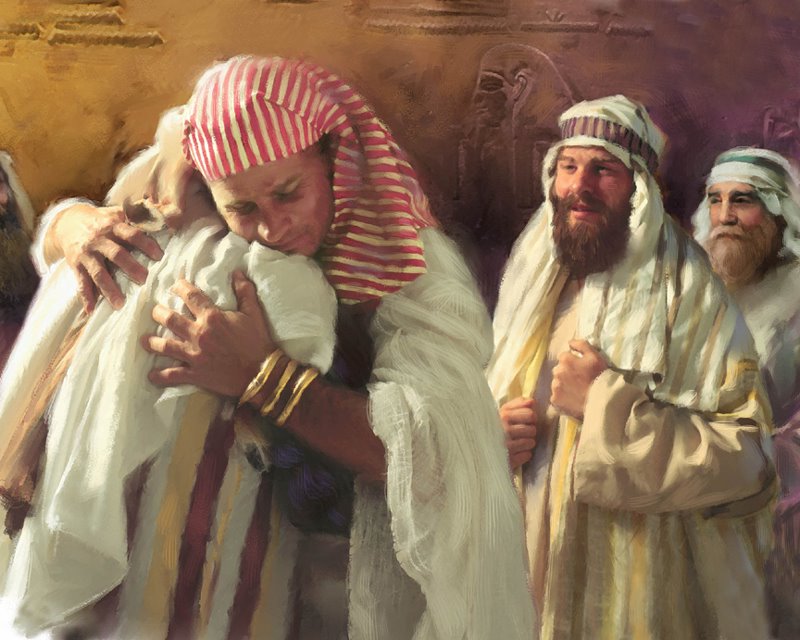
At this point Joseph can stand it no longer, so he orders his staff to leave him alone with his brothers. But he breaks down and begins to sob so loudly that all of Pharaoh’s household can hear him anyway. Finally he tells them who he is and he asks if his father is still alive, but the brothers are too dumbfounded to speak, probably also because he’s speaking their language.
Then Joseph displays his exemplary character again by showing great forgiveness, since it was all God’s plan to save his people from the famine, which would last another five years. The lesson we should learn from this is that God often allows great hardship and tragedy, not to break us but to discipline us and to achieve a greater goal. As the apostle Paul would put it much later, the sufferings of this life are not worthy to be compared to the honor to be revealed in us in eternity. We should strive to be like Joseph also in the way he recognized God’s hand in the events of his life, ordinary though our own lives might seem.
One might wonder why God would have had to take such measures at all, but we could have asked that question back in chapter 3 when Adam and Eve first sinned. God could have snapped his fingers and simply created us all in our eternal state, but surely such a thing would be unworthy of the God who created us in his image. Only a love freely given from a life genuinely lived would be worthy of God.
Constable’s notes include a short list of the many parallels between the life of Joseph and that of the Messiah, and I will add some of the other points to his list here:
- Both were the favored son
- Both made claims to a special position
- Both were hated by their brothers
- Both were betrayed and deemed worthy of death
- while away from their brothers, both secured the means by which they would be saved, and both received a bride
- Both returned from the dead, one figuratively and one literally
- Both became a blessing to Jews and Gentiles alike
Once again we are reminded that God can be trusted to have good reasons for the pain, tragedy, grief, hardship, and bewilderment of life.
Finally, Joseph’s brothers, who couldn’t say a kind word to him before, are able to talk, and we can only imagine what they said. Meanwhile, the word spread throughout Pharaoh’s household that Joseph’s brothers had come, so Pharaoh tells Joseph to spare no expense in seeing to it that all of his brothers, their families and possessions, and their father, all move to Egypt and settle in the best land.
Joseph sends them off with a gentle warning not to fight among themselves alone the way. It takes a bit of convincing for Jacob to believe that Joseph is alive and well, but finally he agrees to move to Egypt.
Gen. 46
Along the way, Jacob gets a visit from God at the place where he had that vision of stairs to the sky so many years before. God tells him that this move to Egypt is his doing, and that his people will become a great nation as promised. But though he himself will die there, his descendants will eventually return to Canaan. Constable points out that the text calls him Israel again here, after he finally believes his son is alive after all. Also, his joy at the realization could be compared to the future joy of the women when they would realize that Jesus had risen from the dead.
Most of the rest of this chapter is a list of all the families, which the Greek text totals as 75 people rather than the Hebrew text’s 70. The difference is possibly due to the Greek text including Joseph’s family, and this is the number also given by the first Christian martyr Stephen in Acts 7:14. Then Joseph meets them in Goshen and they all have a good cry. He also tells them that Egyptians find shepherds repulsive, which would turn out to aid in the people of Israel remaining separate from the surrounding culture, as opposed to their mingling with other people in Canaan.
Gen. 47
Joseph then takes five of his brothers to see Pharaoh, where they repeat what Joseph advised them about their being shepherds. Not only does Pharaoh grant the best land to them, he also puts them in charge of his own flocks and herds, especially since his own people considered that kind of work beneath them. Finally Joseph presents his father to Pharoah, and Jacob gives him a blessing. Pharoah sees to it that he and all his people have whatever they need.
Meanwhile, the famine is reaching the point where Egypt and Canaan have run out of money to buy food, so Joseph tells them to start selling their animals, and when the famine still continues, they have nothing left to offer but themselves and their land. The result was that everyone had to move to the cities where the food was stored, and Pharaoh owned everything and everyone. Only the priests and the Israelites were left untouched. Clearly, God’s promise to Abraham that he would father a great nation and also bless Gentiles is at least partially fulfilled in all this. And Jacob, who had taken his father’s blessing by deceit, would not live as long as his father or grandfather, and would not die in the Promised Land. As for Pharaoh calling the land Rameses, see Constable’s notes on various theories dealing with the fact that the Pharaoh by that name had not yet been born.
This chapter ends with the account of how the group of 75 souls grows exponentially in Egypt, and Jacob’s eventual demand that Joseph must swear to take his bones back to the Promised Land when he dies. This is indisputable proof that Jacob believes God’s promises at the end of his life.
Gen. 48
Now Joseph presents his sons to Jacob, who formally adopts them as his own, making them equal heirs with his other 11 sons. In this way, Joseph actually receives the double portion of birthright normally given to the oldest son. As Constable points out, this also symbolically makes Joseph on an equal level with his father, and he was actually the oldest son of Jacob’s intended first wife Rachael. This is probably why the text has Jacob mention Rachel in vs. 7, which otherwise seems to break the flow of Jacob’s train of thought.
After this, Jacob pronounces his blessing on Joseph’s two sons, but he blesses the younger more than the older, which at this point should come as no surprise to anyone familiar with how God has a habit of going against social norms. Joseph sees this and presumes that his nearly-blind father has put his right hand on the younger son, so he tries to move Jacob’s hands, but Jacob refuses and proceeds with the blessings. This habit of laying on hands
was the ancient method of indicating spiritual blessing or power, and especially in this situation, a formal legal act.
Gen. 49
Now Jacob is ready to pronounce prophetic blessings (and sometimes shame) on all of his own 12 sons, in order by age. Reuben had been the strong firstborn son, but his immorality and wildness mean that he will no longer be prominent— a process we’ve already seen in motion. Constable notes also that the tribe of Reuben would turn out to never figure prominently in the future of Israel.
Next he addresses Simeon and Levi together, the two who had plotted and executed the slaughter of the men of Shechem. Not only are they rebuked for their quickness to shed blood, but also for having a habit of maiming oxen for fun. Their tribes would turn out to be without their own land, reduced to being scattered among the other tribes. But we will see eventually that the tribe of Levi redeems itself in the time of Moses.
In contrast to the others so far, Jacob blesses Judah as the lion
who rules over both his brothers and his enemies. His descendants would always include rulers and leaders until the very day the Messiah comes, as indicated in vs. 10. However, this does not mean there will be no interruptions. After all, not even Judah was such a great person all his life, but he was the one to repent and unify his brothers.
Vs. 11 continues the blessing of Judah, but in terms that undeniably point to the Messiah exclusively, pointing back as they do to the end of vs. 10. This is where predictions are made about him tying a donkey’s colt to a choice vine
and washing his robes in wine
. We may be thinking this refers to his crucifixion and death, but Constable points out that these terms refer instead to the eventual Millennial Kingdom, being symbols of prosperity, blessing, and security. This is further supported by the descriptions of his eyes and teeth. However, we can probably take it as symbolic of Jesus’ death as well, or even the winepress of the wrath of God
during the future Tribulation.
Now Jacob moves on to the other sons, each of whose blessing is a kind of play on words with their name. Zebulun is promised seafront property, Issachar will excel at farming, and Dan will be a judge in Israel. But he adds that Dan will also be like a snake along the road who lies in ambush. It seems from vs.17-18 that the victim will be his own brothers, who cry out to God to be delivered from him.
It is this upon which many believe the future Antichrist will come from the tribe of Dan, though mostly from extra-Biblical sources. But those carry no weight in my estimation, since they’re claiming to be prophetic rather than simply historical.
The few Biblical citations besides this passage include Rev. 7:5-8 which omits Dan from the list of the tribes of Israel, and Jeremiah 8:16-17 which speaks of Dan, the tribe farthest north in in Israel. But that passage also says Dan would be the first to sight the enemy approaching, and it’s the city of Dan rather than the whole tribe. Yet it also speaks of God sending serpents to bite the people of Israel, matching Jacob’s words here. So while it’s remotely possible to make a connection to the Antichist with the tribe of Dan, there is certainly no firm or clear scriptural basis.
Now Jacob moves on to Gad, but in spite of the reference there to attacking the heels of raiders, nobody tries to say that the Antichrist must come from the tribe of Gad. This inconsistency helps us to not be careless in listening to such claims. Asher is simply promised riches, and Naphtail is promised what seems to mean some kind of admiration or attraction.
Then it’s Joseph’s turn, and he is described as the victim of oppression who was ultimately vindicated and avenged by God, who is referred to as the mighty one of Jacob
. The final blessing on Benjamin is of a successful warrior. Then Jacob gives instructions about where he wants his final burial place, near the graves of Abraham, Sarah, Isaac, Rebekah, and Leah. And no sooner than Jacob finishes these instructions and blessings, he breathes his last.
Gen. 50
Joseph then orders the Egyptian undertakers to prepare his father’s body for burial, which undoubtedly involved mummification, since the process took 40 days. Then after the additional 70-day period of mourning, Joseph was granted permission to go to Canaan to bury his father. So off he went, along with a large entourage including his Egyptian household and all his own brothers. The locals, thinking they were all Egyptians, named the place after that event. Note in the Hebrew text that their word for Egypt is Mizraim, which refers to Egypt being divided into two parts, upper and lower.
Now that their father was gone, Joseph’s brothers are afraid that he’ll avenge himself anyway. So they make up a story about Jacob telling them to tell Joseph to forgive them, and Joseph cries as he hears this. He explains again that he can’t be angry with them since it was all in God’s plan to save the entire nation.
In spite of being the second youngest, Joseph realizes in time that he will be next to die. So he makes his brothers swear to take his bones with them in the distant future, after God comes to rescue them— a statement which must have sounded very strange at the time, since they were well-protected and, as far as we know, not aware of the prophecy of their eventual enslavement. So though Joseph’s body is embalmed per Egyptian custom, he is not buried but placed in a coffin to await his eventual departure to the Promised Land when his people will return there.
This concludes our study of the book of Genesis. We have learned that God chooses to work both through and around his people for their ultimate good— or ultimate downfall— depending on their choices. We’ve also learned that in this process God habitually chooses the least likely vessels to carry out his plans. His focus is always on character, though never at the expense of his promises of physical blessings. He looks past a person’s present condition to their future potential, a theme that will be reinforced again in the life of David the despised son of Jesse, and then the lowly town of Bethlehem.


 Bible U
Leave a comment