

back to Genesis
Introduction
This lesson begins the account of Joseph and his brothers. But not even his dysfunctional family will be able to keep him from rising above all the drama to become an illustration of the future Savior. They will try anyway.
Gen. 37
We’ll be referencing the NETS Translation, which is based on the Greek rather than Hebrew Old Testament. As before, we will also refer to the Constable’s notes commentary. You might also want to visit this study if you’re curious about J-names starting with I in the Greek text.
The chapter begins in vs. 2 by saying that Jacob’s son Joseph is 17 years old and helping his older brothers by shepherding the sheep. But the family tradition of favoring one son over another has made his brothers hate him, and all the more since their father gave him a special tunic that signifies royalty or privilege. There doesn’t seem to be a firm concensus on whether it had many colors
or was just ornate or fancy, but it indicates a special position either way.
The incident where he tattled on his wicked brothers certainly didn’t help, but it was about to get orders of magnitude worse. As Constable points out, God’s revelations transition from physical appearances, to dreams and visions, and finaly to what is called providence
or divine activity hidden from our view. In this context the second method is predominant, since God gives visuals but does not speak.
In vs. 5 Joseph has a dream and immediately blurts it out to his brothers. Whether he did this because of knowing the dream was from God, or by arrogance or immaturity, we don’t know. But he has a second dream in vs. 9 which gives the same message: His brothers, and then even his parents, will bow down to him. The repetition confirms the message, which infuriates his brothers even more, and it has his father beginning to wonder what’s going on with his favorite son. So he rebukes him, probably for the first time in his life, but he also seems to wonder what it might mean.
So once again we see God intervening to choose the lowliest and most despised for his purposes, based on inner qualities and not the flesh. Society picks the strong, the persuasive, the charismatic, even the arrogant and oppressive. But what people think is an ugly duckling
often turns out to be a beautiful swan. God doesn’t pick the already-formed diamond, but rather the lump of coal that needs to be put under tremendous pressure to become the diamond. Yet Christians through the centuries have not paid attention to God’s ways, preferring instead to follow pied pipers
.
A. W. Tozer, no perfect theologian by any means, nonetheless had a good statement about this over 50 years ago:
Many tender-minded Christians fear to sin against love by daring to inquire into anything that comes wearing the cloak of Christianity and breathing the name of Jesus. They dare not examine the credentials of the latest prophet to hit their town lest they be guilty of rejecting something which may be of God. They timidly remember how the Pharisees refused to accept Christ when He came, and they do not want to be caught in the same snare, so they either reserve judgment or shut their eyes and accept everything without question. This is supposed to indicate a high degree of spirituality. But in sober fact it indicates no such thing. It may indeed be evidence of the absence of the Holy Spirit.
Gullibility is not synonymous with spirituality. Faith is not a mental habit leading its possessor to open his mouth and swallow everything that has about it the color of the supernatural. ‘Try the spirits’ is a command of the Holy Spirit to the Church. We may sin as certainly by approving the spurious as by rejecting the genuine. And the current habit of refusing to take sides is not the way to avoid the question.
One other point to make before we go on, is that the symbolism of the sun, moon, and stars in Joseph’s dream is referenced in Revelation ch. 12. This passge in Genesis makes it clear that the one in Revelation is describing the nation of Israel, not necessarily, as some believe, a prophetic sign in the sky involving the constellation Virgo. Revelation refers to the Old Testament hundreds of times, so if we truly want to understand Bible prophecy, we must be familiar with passages such as this one in Genesis.
Now back to the text, and in vs. 13 Jacob sends Joseph to check up on his brothers— as one might send a lamb to supervise a pack of wolves. What was he thinking? Not much, because as soon Joseph gets within eyesight of his brothers, they begin to plot his death. But Reuben, surely by divine providence and not a sudden twitch of conscience, tells them just to take him captive. He was actually deceiving them though, because in vs. 22 it says he planned to release Joseph secretly to be returned to their father.
When Joseph gets there, his brothers take away his fancy tunic and throw him into a dry well. Then along comes a caravan on its way to Egypt (vs. 25), and Judah sees the opportunity to sell Joseph to them so they can dispense with him without killing him themselves. But Reuben was away when this all happened, so when he returns and realizes that Joseph is missing, he knows he’s doomed, since as the oldest son his father would hold him responsible for Joseph’s safety.
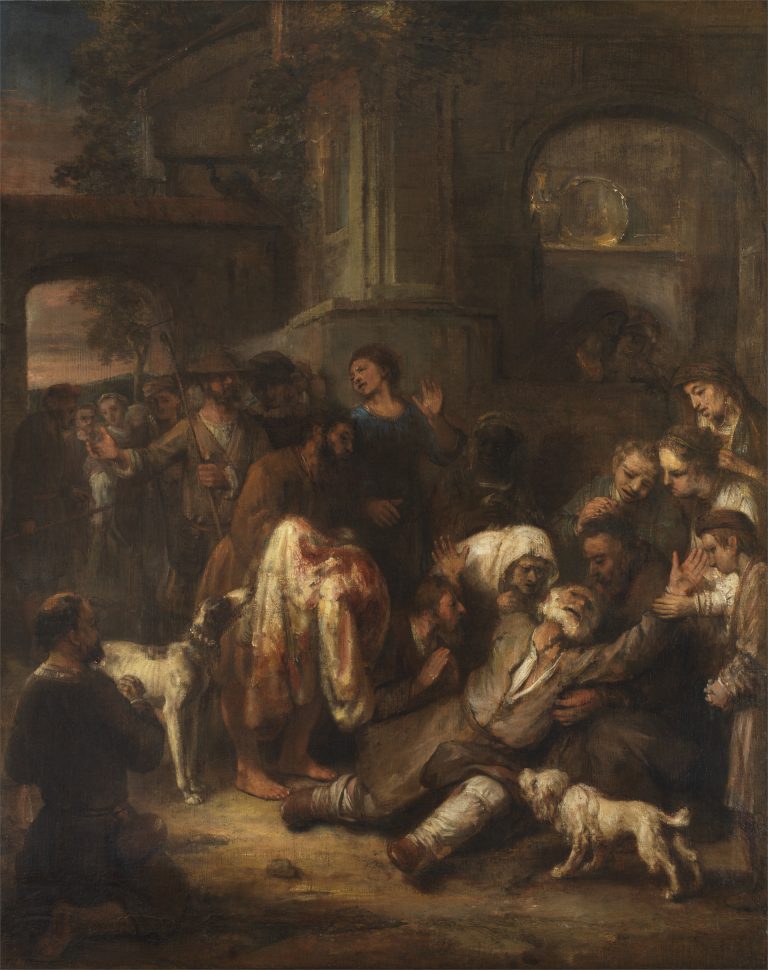
So in keeping with family tradition, the brothers hatch a cover story (vs. 29). They put the blood of a goat all over the fancy tunic, then take it to Jacob and say, Hey, we found this, see if you think it belonged to your son.
They couldn’t even call him their brother, they hated him so much. And as Constable points out, the irony is that it was the skin of goats that fooled Isaac into giving his blessing to their father.
Israel sees this and presumes that Joseph had been torn apart by wild animals, so he goes into deep mourning for a long time. This is the most emotion he has ever shown, another indication to the brothers that they were still second class, even with Joseph out of the way. Constable also points out that Jacob should have remembered the dreams at this point.
The chapter ends by reporting that Joseph was eventually sold to an Egyptian official named Potiphar, who according to Constable was likely the captain of Pharaoh’s bodyguards and executioners.
Gen. 38
Now the text turns away for the time being to focus on Judah and his children. He picks a woman named Tamar (vs. 6) to marry his oldest son Er, but God kills Er because he’s so wicked. Per the tradition of carrying on the bloodline of the childless heir, Judah gives Tamar to Er’s brother Onan. But as vs. 9 tells us, Onan doesn’t want his estate to go to his brother, so he refuses to impregnate Tamar, and again God steps in and puts the man to death. By now we should be getting the impression that God takes his promises of physical heirs very seriously.
At this point, Judah doesn’t want to see any more of his sons killed, and apparently it never crosses his mind to tell them not to be wicked. So he tells Tamar to remain in his household as a widow until his young son grows up. But he was really only stalling, and likely hoping Tamar would not want to wait that long.
Vs. 12 tells us that after a long time had passed, Judah’s wife dies, and then after he mourns for her, he goes off to a certain place to sheer sheep. Tamar, who sees that the young son had grown up but was not being married to her, decides to carry on the family tradition and use deception to get what was her legal right and Judah’s responsibility. Constable explains that it was indeed acceptable for a father to have a child with his daughter-in-law if he had no more sons for her to marry. But Judah had no concern for her rights or his duties and promises.
So Tamar changes her clothing from widow to prostitute and sits in the square of the city where Judah is headed, keeping her face veiled so she won’t be recognized. Then in vs. 16 when Judah asks to sleep with her, she first demands payment. He promises her a goat, but she wants a security deposit in case the goat never arrives, so she demands his ring, his necklace, and his staff. The text doesn’t explain it now, but later we’ll find out that she knows exactly what she’s doing.
After she realizes she’s pregnant by Judah, she changes back into the widow clothes and returns home, per vs. 20. Meanwhile, Judah sends the goat to where he had met what he thought was a cult prostitute
, but she is nowhere to be found, and the locals tell the shepherd who brought the goat that there was never a prostitute there in the first place! So the shepherd returns to Judah with the goat, and Judah decides to just hush up the whole affair, likely due to the embarrassment of being swindled by a woman… not because he had been with a prostitute.
According to vs. 24, three months pass before Tamar can’t hide her condition any longer, and she is reported to Judah as being guilty of prostitution. Judah demands that she be burned to death— never mind that he himself had no qualms about going to prostitutes, even though he could have as many wives and concubines as he could support. How many people today would stand for their spouse having so many partners? How would we feel? This double standard has continued through history and in most cultures, even when society pretends to disapprove.
Now on the way to her execution, Tamar sends Judah a message: Tell me if you recognize these things I got from the man who impregnated me!
As we’d say today, Busted!
Judah knows he can’t hide the truth anymore, but rather than trying to lie about it as we’ve come to expect, he actually admits his own guilt and Tamar’s righteousness. This whole sordid mess was his own fault, and the woman he had treated like garbage turned out to have the moral high ground.
But we can’t end this chapter, and return to Joseph’s account, without one more proof of God’s intervention and his choosing of the younger over the older. In vs. 27 Tamar gives birth to twins, and as the first baby’s arm appears the midwife quickly ties a red ribbon around it to mark him as the older child. But the baby retracts his arm and out comes his brother! The actual firstborn of God’s choosing was named Perez, who would go on to become the ancestor of David.
One thing we can say about this whole family line is that there are many repeating patterns and ironies, and that God clearly has his hand in all this. Above all, it emphasizes God’s seriousness in keeping his promises to Abraham, and the purity of the line through Isaac and Jacob, along with his valuing of women— which, again, is not the sort of fiction any Jew would have invented.
This needs to be kept in mind when we read about the laws of Israel that forbid them to mix with other nations. We, and they, dare not presume that their being the Chosen People has had anything to do with their moral superiority. So they should not look down on Gentiles, and Gentiles should not look down on Jews, or on the other extreme, turn a blind eye to their sins. Chosen they are, and God is not finished with them as a people, but it’s for his glory and not theirs. One thing we can say so far and in the chapters to come, is that this plot has more twists than a bag of pretzels.


 Bible U
Leave a comment