

back to Genesis
Introduction
This lesson will be about how the very good
creation turned sour, along with the promise of redemption. But the details in the original languages are critical to our understanding, so as in prior lessons we will present the scripture and then analyze it.
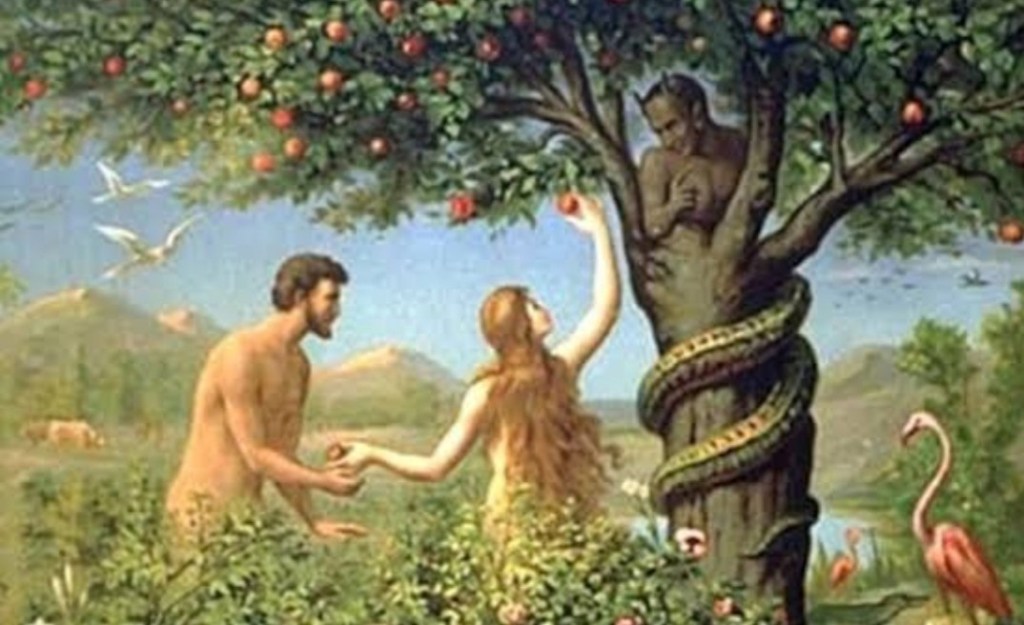
The image here illustrates the nature of the serpent’s temptation of Eve, which is much like the hidden cost associated with ink jet printers.

Text Paraphrase
3:1-4 Now the serpent was the most perceptive among all the wild animals that the Sovereign God had made on the earth, and it spoke to the woman:
Why is it that God told you so sternly that you must not eat from any tree in the paradise?
We may eat the fruit of the trees in the paradise,she replied,except the one in the middle. God said not to eat from it or touch it, so we won’t die.
That’s not true, you won’t die!the serpent replied.God really knows that in the day you eat its fruit, your eyes will be wide open and you’ll be like gods who perceive both good and evil.3:6-7 The woman determined that the tree had good quality fruit, ripe for picking. So she took it and ate it, then gave some also to her husband who was with her, and they both ate the fruit. Their eyes were opened wide, and they realized that they were naked, so they sewed together the leaves of a fig tree to make loincloths for themselves.
3:8-13 Then at dusk they heard the sound of the Sovereign God walking in the paradise. So both Adam and his wife hid from the Sovereign God’s face, behind the tree in the middle of the paradise. God called out to Adam,
Where are you?
I heard the sound of you walking in the paradise,Adam answered.I was afraid because I’m naked, so I hid.
Who informed you that you’re naked?God asked.Did you eat from that tree I told you not to eat from?
You’re the one who gave me the woman!exclaimed Adam.She gave me fruit from that tree and I ate it.Then the Sovereign God turned to the woman and asked,
What have you done?She answered,The serpent tricked me into eating it.3:14-15 So the Sovereign God said this to the serpent:
Because you did this, you are accursed from among all the cattle and wild animals on the earth! You will crawl on your chest and belly, and you’ll be eating dirt for the rest of your life! I will put hostility between you and the woman, and between your offspring and her offspring. He will target your head, and you will target his heel.3:16 To the woman God said this:
Your grief and groaning will be greatly multiplied; in grief you will bear children. You will turn away to your husband, but he will dominate you.3:17-19 To Adam God said this:
Since you heard your wife’s voice and ate from the one tree I told you not to eat from, the land is accursed because of you. All your life you will only eat its produce in grief. Thorns and thistles will make it difficult for you to get food from the field plants. You will eat your bread with sweat on your face, until you return into the earth from which you were formed. You came from dirt, and you will return to dirt!Adam gave his wife the name Lifegiver (Heb. Eve, Gk. Zoe), since she was the mother of all the living, and then the Sovereign God made clothing out of animal skins for both of them.
Then God said,
Look, Adam has become like one of us, perceiving good and evil. We must prevent him from reaching out to take food from the Tree of Life and live perpetually.So the Sovereign God expelled him from the pristine paradise and sent him to work the ground from which he had been taken. And after he threw Adam outside of the pristine paradise, he ordered cherubim with the flaming broadsword to turn away any intruders, to guard the way to Tree of Life.
Commentary
For some reason, Moses didn’t think it necessary to explain the serpent’s cunning, but simply to report it. Yet Rev. 20:2 identifies what it calls the ancient serpent
as the same entity as the dragon, the devil, and Satan. Still, we can’t ignore the fact that snakes have always moved according to the result of the curse, so this seems to be a both/and situation. Moses emphasizes the serpent’s cunning rather than its nature.
But notice that in the Greek text the serpent does not say Has God really said
, but Why has God said
. The Hebrew text has the serpent sowing doubt about what God said, but the Greek text has the serpent getting Eve to ask why God said it, a question she certainly would never have asked without the serpent’s influence. To me, that strategy seems more aligned with the serpent’s cunning and calculating, and Eve’s response is the key: she gave the reason for the rule. Not one place in the entire Bible faults Eve for changing the wording of the rule, or being mistaken about it.
The serpent’s tactic is familiar in our everyday lives, in the form of steering and manipulation, which is an effective strategy because it’s very subtle, planting ideas rather than forcing them. It had never occured to Eve that God would withhold something good from her, so she was unprepared for such a thing. She thought the reason for the rule was that she would die, but the serpent made up a new reason, and she had no exprience to tell her that the serpent, or anyone else, would lie to her.
So can we really fault Eve for having no concept of deception? Scripture never tells us why it was Eve rather than Adam that was targeted for this deception; we can only speculate, and again we must use extreme caution in doing so. But per the question asked in the lesson on ch. 2, why did God say it was not good for the first human to be alone, and why was that human charged with guarding Eden? All we can speculate at this point that Eve was targeted because she had no direct observation of God’s creative power, and she was the guardian’s guardian, so to speak.
What the serpent was offering was the promise of being not only like God, but also what today is called being enlightened or awake. This is the very definition of Gnosticism: hidden knowledge given only to those who are made worthy by taking a certain path of discovery, marked out by those claiming to be wiser. There are variations within Gnosticism, but the teaching that the serpent was trying to free mankind from the clutches of the evil demiurge creator is at the core of Gnosticism in general. This is what fooled Eve, and what continues to fool many others to this day. At least she had a valid excuse.
Keep in mind that none of this has to do with any fictional story about Eve lusting after some imaginary authority Adam held over her, and especially not with the vulgar Gnostic (or Talmudic, or Kabbalistic) belief that Eve had sexual relations with the serpent. In order to allegorize the fruit in this context to mean lust, one would have to allegorize the entire creation account with its description of trees and fruit. This is a dishonest and prejudiced approach to scripture, and one which renders all Bible study pointless since allegories can mean just about anything.
Notice also that Adam was there with Eve when she was being manipulated by the serpent’s cunning, per vs. 6. So by the absurd theory about Eve mating with the serpent, we could also lay the same charge against Adam, who also ate the fruit. Yet neither of them got the fruit from the serpent, but from the tree. This particularly vulgar teaching is known as the serpent seed theory, one that only the vile serpent could invent, and it’s easily debunked by Gen. 4:1.
Now we must put to rest the equally absurd notion that Eve tempted Adam to eat the fruit. Scripture never hints at such a thing; rather, it clearly portrays Eve as the victim of temptation and deception. Only a sinful desire to make Eve the real villain can result in such victim-blaming. The text states that she handed the fruit to Adam who was with her, and he ate it without having to be fooled as Eve was. Many try to take the phrase listened to the voice of your wife
as proof of her enticement of Adam, but no part of scripture ever gives it that meaning. In the few instances where Eve is mentioned outside of Genesis, she is the victim of the serpent’s trickery.
Rom. 5:12 states that Adam, not Eve, is the reason death entered the world. But how can this be, since both of them ate the fruit and both eventually died? Again, there is more going on here than meets the eye, and again we must be cautious. We will see the probable reason shortly.
Some claim that Adam was charged with sin and confronted first because he was the federal head of humanity
, which of course is not found in scripture. The real reason is the structure of this confrontation, namely that it is in the form of a chiastic argument, pictured by the Greek letter chi which looks like an X. Someone makes a series of points toward a central point, then traces back through the points in reverse order. Thus we can find the central point being made by watching for where the pivot point begins. And in this case, the pivot point is the curse on the serpent and subsequent remedy through the seed of the woman. The order is man / woman / serpent / woman / man. So this order of confrontation has more to do with making a point than with some alleged Adamic authority.
But notice Adam’s reaction when God asks him about the fruit: he blames Eve directly and God Himself indirectly, by saying the woman you gave me
! The serpent and the temptation are never mentioned by Adam; he takes no responsibility and shows no remorse or compassion for Eve, as some claim. He had stood silently by while listening to the serpent deceive his wife, and he took the fruit from her without comment or question.
When Eve is confronted she simply states the truth: The serpent deceived me and I ate.
No passing blame to Adam, no argument about what a great idea eating the fruit was supposed to be, no protest about it being unfair that she was beneath Adam… just telling what happened.
At this point God doesn’t even ask the serpent any questions but simply curses it. But notice that God begins with Because you have done this
. And in this context of cursing the serpent, God pronounces the ultimate remedy: the seed of the woman. No one has thought to ask why it would be the seed of only the woman that would bring the remedy for this disaster. Why was Adam not to be a part of this? Scripture never says. But it’s a question everyone should ponder.
God never says to Eve, Because you have done this
. And what God does say is disputed: Was it I will multiply your suffering in childbirth
, or A snare has increased your sorrow; in sorrow you will bear children
? Regardless, the point is that Eve is never told that something she did is the reason for this, as was the case with Adam and the serpent.
Then God makes a prediction (not a command): Eve would turn toward her husband. The Greek word is apostrophe, but most study tools give the wrong definition. This turning is lifted from context and given all sorts of imaginative meanings by many. They say it must be sexual desire, or lust for power, but scripture says no such things. Whatever anyone insists, the fact remains that it did not exist until after the serpent tempted her. Genesis 2-1/2 is pure fiction.
God is telling Eve that she is about to make a critical choice, and that this choice would result in something that did not exist before, or it wouldn’t be predicted: Her husband would rule over her. Had this rule already existed God would have only said that it would be stronger or harsher, but since no such rule is stated anywhere before this in any form, the context only supports the existence of rule by Adam over Eve after sin. It is the man who will now usurp authority over the woman, whom God had created as his equal. Ironically, today many men accuse women who want equality of attempting to usurp the very authority they themselves got by usurping.
We must also consider the fact that God had just finished telling the serpent that the woman he beguiled would be his ultimate undoing, and that God himself would put hostility between them. This is no physical fear of snakes (besides, fear and hostility are two completely different things) on the part of only women, but a special seething hatred between the forces of Satan and the progeny of only Eve, since from her seed alone would come the promised Savior. Eve was clearly being compensated for her having been the victim of a cruel deception, and Adam was truly in need of her help.
Finally we come to Adam. God begins with Since you did this
, so we know that Adam is being held responsible for his actions, just as the serpent was. But remember that the only penalty God had stated for eating the fruit was death. Both Adam and Eve ate the fruit and eventually died, but no other penalty was stated. So why were there additional penalties for Adam alone, whom the text clearly and repeatedly aims at? The only option the text gives us is that it was for his open and unprovoked rebellion against God, his blaming God for making Eve.
Notice that it is not Adam himself but the ground he was made from that is cursed; there is no curse on Adam, Eve, or human nature. Then Adam is told he would have to work hard to get this cursed ground to produce food, and it is only to Adam that God says you came from dust and will return to dust
.
Eve, just as God predicted, chose willingly to share in Adam’s fate and follow him out. Tragically, many teach that Christian women should make the same mistake and follow men rather than God, because they are all temptresses who need a sinful, blame-shifting man to keep them in line.
As for the class of angels called cherubim who were put there to guard the way to the Tree of Life, we have little to explain any details, other than that scripture seems to portray them as having very high rank.
Conclusion
There are few passages of scripture more badly twisted than Gen. 3. Because of this, any New Testament references to it are also badly twisted. Everything that was to happen after this point would be the result of rebellion against God, not what God would call very good
.


 Bible U
Leave a comment