

back to Genesis
Introduction
This lesson is all about Isaac: his birth from Sarah, his being nearly sacrificed by Abraham, and his eventual marriage to Rebecca.
Gen. 21
This chapter begins with the birth of Isaac, whose name means laughter
, which the text says is about people rejoicing with Sarah, but is also certainly a reference to the fact that both Abraham and Sarah laughed at the prospect of having their own child in their old age.
But one day the older son Ishmael was caught mocking Isaac, just as Ishmael’s mother had mocked Isaac’s mother, so Sarah told Abraham to get rid of him and his mother. This time Abraham didn’t want to do what Sarah wanted, but God told him to listen to her, which no self-respecting man would tolerate in today’s Christianity. And the reason God gives is Abraham’s offspring had to be traced through Sarah’s son Isaac. Again we see that not all of Abraham’s natural children are heirs of the promise and covenant, which is confirmed in Gal. 4:30.
So Abraham sends them off with provisions, but when those run out, Hagar expects they’ll both die. Yet God, still showing mercy, and still showing that he keeps his promises to even a slave woman, showed her where water was. They stayed in the wilderness, while Abraham settled in the land of the Philistines.
As a historical note, when the nation of Israel was expelled from the land late in the 1st century a.d. by the Romans, they further humiliated the Jews by naming the land after their arch-enemies the Philistines— which in their language was pronounced Palestine.
Gen. 22
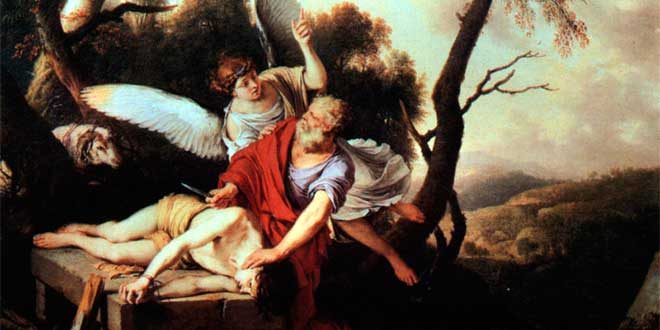
This chapter is where we see an incident widely condemned by Bible critics and anti-theists: God tests Abraham’s faith by telling him to sacrifice Isaac. But before we go over that, we need to clarify that Isaac was likely not a small child by this time, so please take a look at this article.
So God tells Abraham to take his nearly full-grown son, the one he kept promising him, to go to a certain place to kill him in sacrifice. But while the text we have tells us nothing of what was going on in Abraham’s head, Heb. 11:19 does: Abraham reasoned that God could even raise the dead.
This is Abraham’s deep faith; that God will keep his promises, even if it means raising someone from the dead. We do have a hint of that in vs. 5, when Abraham tells the servants that came with them: Wait here while we go off to worship, and then we will return.
Be careful not to gloss over vs. 8, where Abraham answers Isaac’s question about needing an animal for the sacrifice by replying, God will provide himself a sheep for the offering.
This is clearly a prophetic reference to the eventual sacrifice of the Lamb of God, to which the later Passover feast would also point in more detail. Not only is this a test of Abraham’s faith, it’s a type and shadow of the Messiah. That’s the purpose of this incident— not to appease a bloodthirsty demigod as the critics allege, but to illustrate Abraham’s faith in the God who raises the dead.
Notice also that vs. 11 says no sacrifice actually took place anyway. God waited till the last second, when Abraham had raised the knife in the air, to stop him. Abraham had passed the test, one that must also have been for the benefit of the angelic beings who always watch what goes on in the world. God needed no test to know what was in Abraham’s heart, but others need something tangible to point to.
To make a quick side note, isn’t this the essence of what the book of James is teaching? James doesn’t say that someone is unsaved if they don’t do certain good works, which works salvationists
can’t agree on anyway. Rather, he’s saying that a hidden and inactive faith does no one any good. If God tested Abraham for the benefit of angels and people, then we too should demonstrate our faith in tangible ways— not to become saved or stay saved, but because we are saved. If we grasp the essence of the Gospel, we will naturally want to act on it. James is simply warning those who fail to do so, that they need to ask themselves if they really are saved.
Now back to Genesis, starting in vs. 13. Not only does God prevent the sacrifice of Isaac, he also provides the animal: a ram caught in a thicket nearby. And when God repeats his promise of making a great nation out of Abraham, he refers to Isaac as his only son, even though he also had Ishmael. God also swears this by himself, so it can never depend on what anyone would do or fail to do in the future. But notice that starting in vs. 11 God is described again as the angel of the Lord
, and as noted in an earlier lesson, this is clearly a Person of the Trinity, and likely the pre-incarnate Christ. Who better to provide the sacrificial sheep?
Gen. 23
The rest of ch. 22 lists the children born to Abraham’s brother, so take a quick look at ch. 23 in this parallel Greek and NIV source, which is all about the death of Abraham’s wife Sarah at the age of 127.
Gen. 24
This chapter is about Abraham not wanting Isaac to get a wife from the local Canaanite women, so he sends his servant to get one from his relatives. But she is not to be taken by force; if she (or her family, per social norms) refuses, then the servant is released from his oath to carry out Abraham’s wishes.
So the servant asks God to help him identify the one
, and the prayer was answered even before he finished it. He learns that the woman, Rebecca, is among Abraham’s relatives, and he is invited to spend the night among them. Her brother Laban will turn out to be a conniving man, but we’ll learn more about that in a future lesson.
In vs. 63 we see that just when the servant reaches home with Rebecca, Isaac has gone out to a field to meditate. Some commentaries take the word to mean pray, but since vs. 67 tells us that his marriage to Rebecca comforts him after the death of his mother Sarah, the meaning may lean more toward him just processing his grief by walking alone in nature. The idea that this meditation resembled in any way the heathen practice of silencing the mind or opening chackras is complete nonsense.

 Bible U
Leave a comment