

back to Genesis
Introduction
This lesson covers the account of Sodom and Gomorrah, Abram’s meeting with Melchizedek, a prophecy about Israel’s eventual enslavement in Egypt, and why it’s bad for people to try and help God fulfill his promises when he seems to take too long.
Gen. 14
This chapter begins by introducing the cities of Sodom and Gomorrah, who were allies in various battles against surrounding armies near the Dead (Salt) Sea. But the enemies won, and 14 years later the conquerors also decimated the Rephaim per the Hebrew term, which the Greek text simply gives as giants.
From what I could find, the figurative meaning refers to the spirits of the dead, but the literal meaning is of fierce, strong people of tall stature who lived in Canaan. Deut. 2:20-21 is one source for this, and 3:11 describes King Og of Bashan as the last of them, and that his iron bed was 13 feet long and 6 feet wide. From the various names in scripture, it seems that they referred to different tribes or family lines of angel-human hybrids, just as people are separated by tribes or family lines.
This is, in my opinion, where some popular conspiracy celebrities got the idea that there are races of space aliens. But such beings don’t come from space; their fathers fell from heaven, and they are the demons, the disembodied spirits of the giants of long ago.
We see in vs. 12 that Lot was among the captives when Sodom was defeated. Someone ran to tell Abram, who mustered an army of his own servants and recovered all the captives from Sodom. This takes us to vs. 18, where Abram meets the mysterious Melchizedek, king of Salem and priest of the Most High God. As was the custom of the time, Abram gives this person a tenth of the spoils of war. This is the one and only time Abram is said to tithe
, and it was not from his own crops and herds but from those of his defeated enemy. Some try desperately to use this as a proof that Christians must tithe to churches, since it predates the laws of Moses. But so also does the law of circumcision, and I don’t see those same people clamoring to make that binding on all Christians.
Gen. 15
This where God appears to Abram again and reminds him of his promises. But this time, Abram asks God how this will happen, since he has no child. The closest legal heir would be the son of one of his slaves, but God states again that the promise was that the child would come from him. Verse 6 is where we find the famous statement that Abram was considered righteous solely on the basis of his choice to believe what God promised him.
But right away, Abram asks God for proof that he will inherit the land. Why this required proof, and the promise of physical descendants did not, we aren’t told. But God granted his request anyway, and in vs. 13 God tells him that his descendants will travel to a foreign land where they will be enslaved for 400 years, after which they’ll leave with great wealth. Verse 16 has a curious statement as well: that the sins of the Amorites needed time to reach a certain point. We should remember this whenever God seems to let a lot of time pass when to us it seems inexplicable.
We also see in this section the practice of making a covenant by killing animals and dividing the pieces into two rows, then having the parties to the covenant pass between the halves. It’s a literal cutting of a blood covenant, meaning may this happen to me if I don’t keep my oath
. But it was only God, represented by the flaming torch and pot of smoke, who passed between the halves, so only God was responsible for keeping the covenant. This is what Heb. 6:13-18 refers to.
God also gives specific details about what Abram and his descendants would receive: land from the Nile to the Euphrates, where many people groups lived, including the Rephaim. Critics cite the eventual genocide of these people as an indictment against God, but the presence of the Rephaim, known for their viciousness as all the giants were, should tell us that God was doing mankind a service. Many who fault God for violence would gladly commit violence against God and all who worship him.
Gen. 16
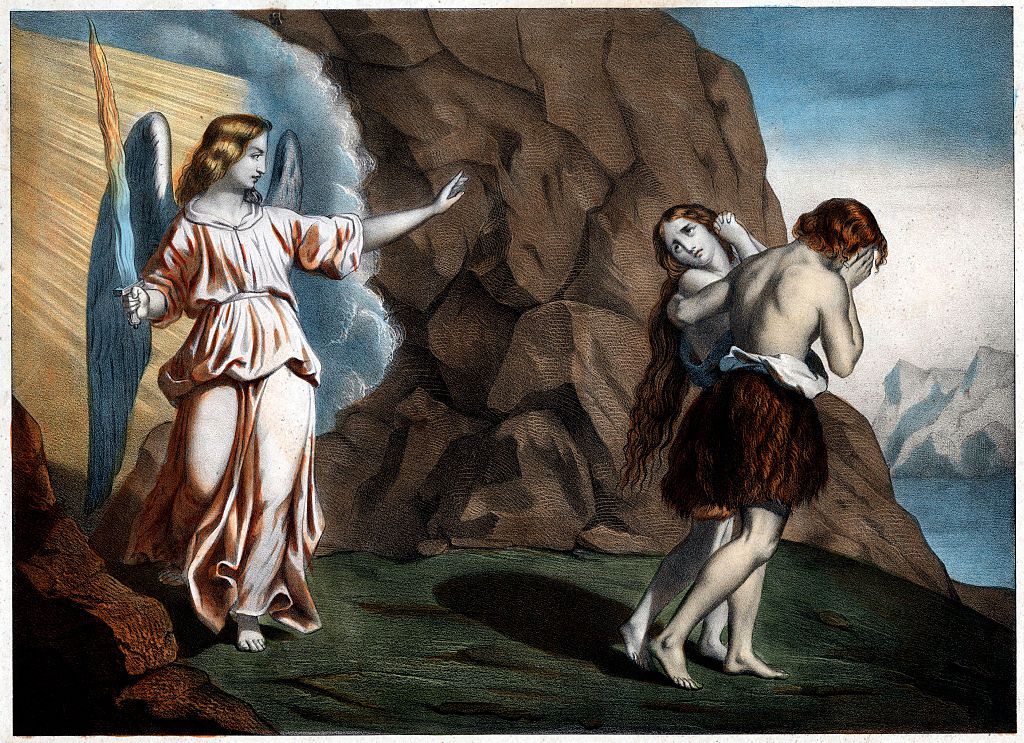
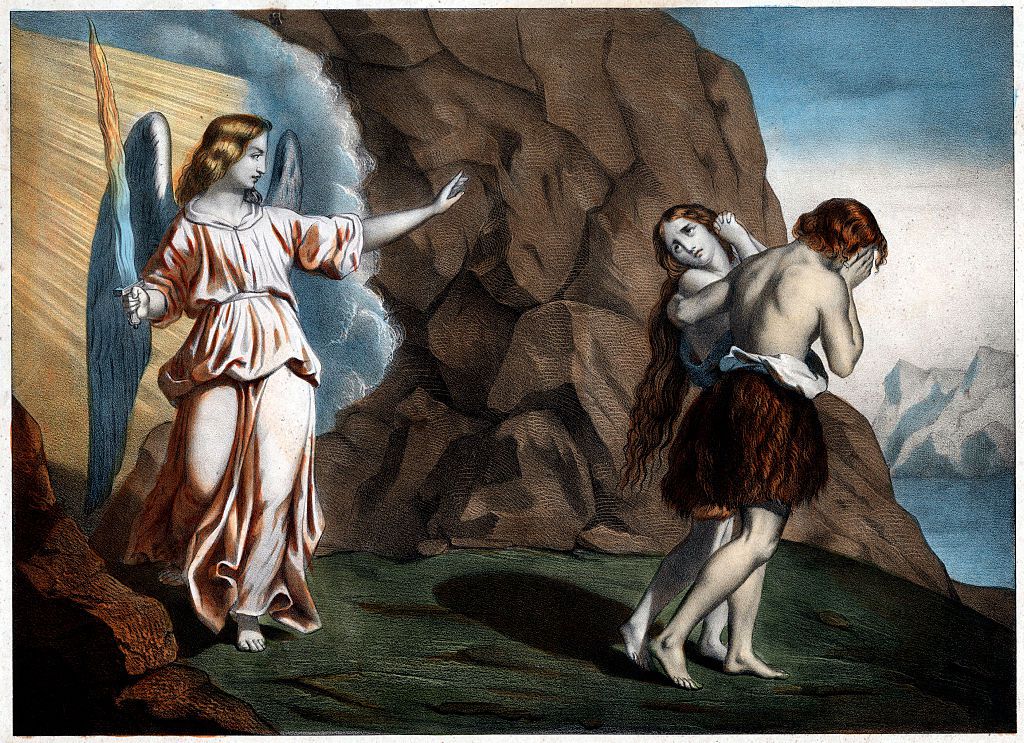
This chapter focuses on Abram’s wife Sarah, who also would eventually have her name slightly changed. But she became impatient regarding God’s promise, so she decided what social norms would advise for reasons of legal inheritance: She told Abram to have a child with her handmaid Hagar. To say this was a big mistake is quite an understatement, just as Eve made a big mistake in following Adam out of Eden. From this union would come people groups that would be thorns in the side of Israel right up to the present day.
So Abram agreed, and nothing is said or implied that Sarah nagged or manipulated him. But when Hagar actually became pregnant with the child Sarah wanted, she flaunted her success in front of Sarah, setting the tone for the rest of middle eastern history as we know it. Once again we see why taking the Bible literally helps us understand the times we live in, particularly the deep, underlying causes of middle eastern conflict, being ancient and supernatural.
Of course, Sarah was irate about this, but she goes to Abram and says This is all your fault!
, in a kind of echo of Adam’s blame-shifting against Eve. So Abram tells her she can do as she pleases with Hagar, and she proceeds to mistreat her. Then Hagar runs away, but vs. 7 says that an angel of God comes to comfort her and tell her to go back to Sarah, apparently since Sarah was really the instigator of all this.
But is this merely an angel, or a phrase many interpret as referring to the pre-incarnate Christ? The wording would suggest that this is the latter. So God himself has appeared to a mere slave woman, and he promises her that she too will be the mother of uncountable descendants. Notice that vs. 10 speaks of her seed. Some claim that scripture never speaks of women having seed with the lone exception of the virgin Mary. Curiously though, the rest of scipture speaks of only male lines of descent.
Now this promise is not all rainbows and lollipops: Her child, whom God tells her to name Ishmael (God Hears), will be wild and antagonistic. But then in vs. 13 it is the lowly woman who gives God a name: Beer Lahai Roi (God Sees Me). So much for the claim that Adam naming Eve was proof of his authority over her.
The chapter ends by noting that Abram was 86 years old when the child was born, and again we would ask why this matters if this were all an allegory.
Gen. 17
This chapter states that Abram was 99 when God appeared to him again, 13 years after the birth of Ishmael. This is when God changes his name from Abram (Exalted Father) to Abraham (Father of Many Nations). God adds that kings will be among his descendants, and again one wonders what the allegorists do with such details.
Let’s pause at vs. 7 to address a teaching known as Fulfillment Theology, taught in recent years by people such as Dr. Gary Burge at a conference in Bethlehem called Christ at the Checkpoint. This view claims that since Paul in Gal. 3:16 says the promises were only to one particular descendant of Abraham, that being the Messiah, then either the promises are completely fulfilled and nothing remains, or Paul contradicts Moses; after all, vs. 7 says that this covenant is not just with Abraham himself but also his descendants forever. This sort of teaching underscores the importance of the whole counsel of God
, of knowing all the scriptures so we don’t twist Paul’s words, which Peter said was already happening in his time.
Didn’t this same Paul also state in Rom. 11 that God has not rejected his people, whom he defines there as the family of Abraham, and that God chose the people of Israel before they were born? Paul calls himself an Israelite from the seed of Abraham. The context makes it clear that he is referring to physical Israel. In fact, the entire letter to the Romans is about the unity of two groups, not the abandonment of one, and ch. 11 is a warning to any who would boast over the natural branches. The wild do not replace the natural; they are both joined to the vine, not to each other.
So is there a conflict between God’s promise to Abraham that his physical descendants would be uncountable and have a specified land, and Paul’s statements in Galatians 3:16? God’s promises to Abraham were undeniably physical and included countless physical descendants, and Paul would not contradict such clear statements. Certainly Jesus did fulfill everything, and all the promises and prophecies point to him. But it’s terrible theology and logic to leap from there to turning God’s promises to the nation of Israel into allegorical mush. Does the Messiah need the land God promised so clearly in Gen. 17:8?
Then in vs. 10 we see the sign of circumcision. Why is the sign only for males? Scripture does not tell us, and it also applied even to men who were not Abraham’s direct descendants. From that it’s clear that this covenant includes a nation, which is more than just Abraham’s own descendants. Other nations also practiced this, so again we ask why God ordered it. The only difference is the precise physical land, and the nation in that land. So the first point we can make is that it signifies the covenant with the nation of Israel.
A second point we could make is that it may be because Abraham should not have fathered Ishmael in the first place, and this would remind them all of the dire consequences of breaking faith with God. But speculation aside, what we cannot say is that this is some kind of sign of male entitlement, or that it was replaced by water baptism, especially since women can also be baptized.
Now in vs. 15 God renames Sarah as well, but this change is more subtle since both forms meant Princess. It is believed that her former name meant My Princess, as if God was expanding her royalty to many rather than one.
When Abraham heard God say that Sarah, who was 90 years old, would physically bear a child, he laughed. God seems to have ignored that for now, but later he asks why Sarah also laughed, and she was embarrased at being called out for it. Why God only did that to her and not Abraham, scripture doesn’t say. But it does say that God would also bless Ishmael, though he would only establish his covenant with Isaac.
In time it would turn out as God warned: Ishmael would be a wild and hostile man, who would not be included in the covenant with Abraham. Thus we see the separation and distinction even among Abraham’s physical children, and the importance of the promise extending through only the line of Sarah to Isaac.
Knowing all this, the term Abrahamic religions
should make us cringe. Abraham did not pass on any religion, and his obedience to the one true God only continued with Isaac and his line, not Ishmael and his line. We will see elsewhere in the Old Testament that only Israel could trace physical lineage back to the faith of Abraham through Isaac and his son Jacob— but not through Jacob’s twin brother Esau. Only Torah Judaism and Christianity can remotely be called Abrahamic religions.

 Bible U
Leave a comment