

back to Exodus
Introduction
 This lesson covers from Moses’ first confrontation with Pharaoh, to the 9th of 10 plagues. Again, please refer to these resources as well: this commentary, the NETS Bible, and this LXX Interlinear.
Ex. 5
As mentioned in the previous lesson, the 3-day journey Moses tells Pharaoh to grant Israel to worship God is a diplomatic expression meaning “we intend to leave and never come back”. Verse 8 is where Pharaoh decides that the only reason this request has been made is because the slaves have too much free time and spend it listening to troublemakers like Moses. So in his infinite wisdom, he turns the screws tighter by making them go out and scavenge for the straw they need to make bricks.
By verse 10 we see that quotas are not being met, so the Hebrew foremen are being beaten. As the saying goes, “The beatings will continue until morale improves!” So the foremen go to Pharaoh to ask why they’re being beaten for this unreasonable demand, and as they leave the court without relief, they meet Moses and Aaron. The foremen vent their anger on them, blaming them for their suffering. In turn, Moses whines to God that not only has Pharaoh not let the people go, he has made them shoot the messenger, who didn’t want to do this in the first place.
Ex. 6
So God repeats his assurance and the promise he made to Abraham and Isaac, then commands Moses to pass this on to the people of Israel. But of course, the Israelites aren’t in any mood to listen. Even so, God tells Moses to try a second time with Pharaoh, and Moses repeats his claim of being a poor speaker in spite of such a statement making God angry at him the first time he said it.
At verse 14 the text stops to do a genealogy of the sons of Levi, and we might wonder why here and now. But Constable’s notes argues that it’s to establish the pedigree of Moses and Aaron, since Israel isn’t listening to them anymore. There’s also a handy genealogical chart in those notes.
Ex. 7
This chapter begins with a curious statement from God: that he has made Moses like God to Pharaoh, and Aaron like Moses’ prophet. But the Pharaohs by this time had come to be regarded as literal gods, who would simply pass from one mortal body to the next as each one wore out and died. So God is both putting Pharaoh in his place and giving confidence to Moses. But he adds that he will be the reason Pharaoh’s heart becomes hard, so Moses should expect more resistance rather than any progress at this time. Then we’re told that Moses is now 80 years old and Aaron is 83.
Now what does it mean that God hardens Pharaoh’s heart? Does God override a person’s free will? We have already seen the freely-chosen condition of this Pharaoh’s heart, being arrogant and disrespectful of any other claims to divine authority over him. He has shown his character in no uncertain terms. There are several ways to look at this:
- God created Pharaoh to be evil; Pharaoh had no free will to be anything else.
- God does the hardening, but it’s only a change of degree rather than kind.
- Pharaoh will choose to resist God, so God is the excuse; God doesn’t literally harden his heart for him. This is the same principle as when we say another person made us angry; the anger is our chosen response, not that the person literally forced anger upon us.
The third option seems the most likely in light of the grammar and the reluctance of God to destroy the wicked (Ezk. 18:23, 33:11, 2 Peter 3:9).
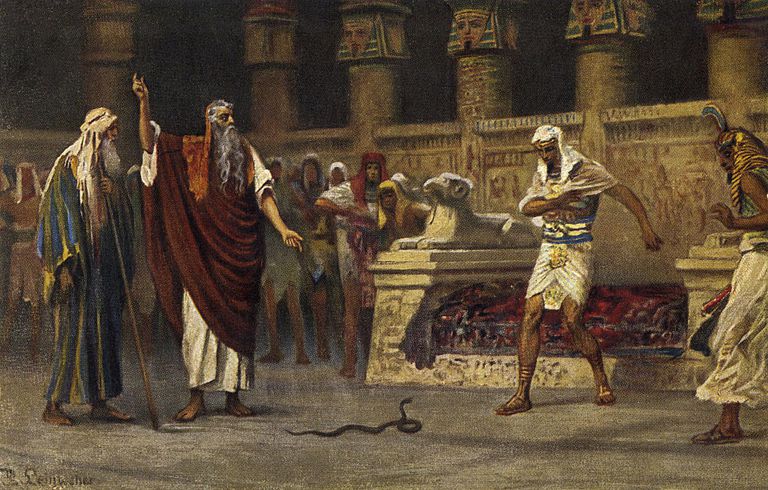
Now when they appear before Pharaoh as before, this time he demands a miraculous sign just as God said he would. So Aaron throws down his staff and it turns into a snake, though the LXX text in this chapter uses the word for dragon, whereas it used serpent in chapter 4. But the Egyptian sorcerers are able to turn their staffs into these creatures as well. Even so, Aaron’s staff then swallows all the sorcerer’s staffs, but Pharaoh is not impressed. Symbolically, the consuming of Egyptian staffs meant that God had sovereignty over Pharaoh, but he rejected the claim.
Verse 14 is where the actual plagues begin. Since Pharaoh basically yawned at the miraculous sign of the staff becoming a living creature, God is upping the ante: Moses will intercept Pharaoh at the Nile and turn it to blood, including water that was already taken from there and stored in containers. This would kill all the fish and make a stench, and no one would be able to use Nile water, which of course was central to their lives.
Constable notes that various natural plagues such as of frogs, bugs, hail, and even darkness were common seasonal problems, but here God is going to directly control their timing, their intensity, and in some cases, their selectiveness in afflicting only the Egyptians. The notes also state that these plagues all take place in northern Egypt near Zoan, per Psalm 78:43, which is either the same as or near Goshen. God has prepared Moses, and now he is preparing Pharaoh.
So Moses and Aaron do as God commands, and the result is as God had told them. But again, the Egyptian soothsayers do the same, so again Pharaoh yawns and goes home. It would have been much more impressive if the soothsayers could undo what Moses did, instead of only copying and making things worse for their people. This condition lasts for seven days, which if it were merely the seasonal redness from flooding, would have lasted about 3 months, and the water would still have been drinkable and not deadly to the fish.
Ex. 8
The 2nd plague is that the Nile will swarm with frogs, and they will come out onto the land and enter all the houses. As one of many sacred animals, a person could be put to death even for killing one accidentally, so having them underfoot would be a huge problem for the Egyptians. Only after this happens does Pharaoh ask Moses and Aaron to end the plague, and again we note that he doesn’t ask his sorcerers to do so, obviously because they’re unable. But God, through Moses, lets Pharaoh decide the moment the plague is to end. When it does, the land reeks with piles of dead frogs, which might have put a dent in the people’s reverence for them as sacred animals. But like many of us, as soon as God answers the prayer, Pharaoh retracts his promise to let Israel go.
The 3rd plague is of gnats, though it could also mean lice or fleas or even mosquitoes. But this time the soothsayers can’t duplicate the plague, and they recognize a divine power their dark arts can’t match. Pharaoh just shrugs it off, even though his own magicians were outmatched and have just admitted to using tricks instead of actually having power.
The 4th plague is of something called dogflies, but just to make sure the Egyptians don’t think Moses is working for any run-of-the-mill deity, God only sends it on them and not the land where the Israelites live. And this time God does it without requiring any action on the part of Moses or Aaron. Constable notes that these flies preferred to latch onto people’s eyelids, and could actually cause disfigurment through swelling caused by stings. Not even Pharaoh’s house was spared, but though he finally agrees to let Israel worship God, he wants them to do so in Egypt. Yet since such worship would involve animal sacrifice the Egyptians would kill them, so they have to leave Egypt entirely. God will not compromise or strike a deal, and Moses warns Pharaoh not to lie again. Pharaoh relents, but once again, as soon as Moses prays for God to end the plague, Pharaoh breaks his word.
Ex. 9
The 5th plague is of a terrible disease on cattle, horses, oxen, and sheep— in other words, their work and farm animals— and again the land of Goshen is spared. This time Pharaoh makes no offers or promises, but digs in his heels and refuses to let Israel go.
The 6th plague is of terrible boils that break out on the skin of all the Egyptians and their animals, after Moses throws handfuls of soot into the air as Pharaoh watches. He still couldn’t care less.
If all of that wasn’t enough, the 7th plague will prove once and for all that Egypt has no god like the God of Israel. God explains to Pharaoh, through Moses and Aaron, that the only reason Egypt hasn’t been totally and instantly wiped out is because God is using all this to prove his point. But this time he gives a warning to whoever among the Egyptians chooses to listen: Put your people and animals under strong shelter, because a hail storm is coming, the likes of which will never have been seen in Egypt before. Some of Pharaoh’s attendants listen, but others don’t. So even in this, God is showing mercy to the Egyptians on an individual basis.
The plague turned out to be not only the hail itself, but also loud thunder and fire that, as the LXX puts it, “ran about on the land”. Lightning is referred to as fire in verse 24, so we could speculate that this might have been something like ball lightning, though some commentators think it means that lightning strikes caused fires which spread on the land. Regardless, none of this affected the land of Goshen.
Now God has Pharaoh’s attention and he confesses the sins of himself and his people. But Moses knows better than to think he’s being honest this time, even though all their crops were ruined, except the later harvests, and many people and animals had died. And as expected, when the plague stops, so does Pharaoh’s shallow guilt trip and even shallower promise.
Ex. 10
God is about to unleash the 8th plague, and he tells Moses that this will make fools of Pharaoh and his court. This time it’s locusts, who will cover the land and strip it of whatever the hail plague hadn’t pulverized. As soon as Moses leaves Pharaoh’s court, his advisors ask him if he’s even aware that Egypt is already in ruins. But Pharaoh’s retort is that Israel will indeed need their God’s help if he lets more than just the Hebrew men leave the country— meaning he’d rather they all died than to let them all go.
God sends the plague, and again Pharaoh pretends to “really mean it this time”. Moses prays for relief anyway, though to no avail, and the stalemate continues even if it means the ruin of Egypt.
The 9th plague— palpable, gloomy darkness— again comes on only the Egyptians, even without Moses saying anything to Pharaoh. It lasts for three full days, which some say also foreshadows a future prophetic event. But no such thing is prophesied except over the kingdom of the Beast during the Tribulation, and it doesn’t say the number of days. Now when Pharaoh summons Moses and tells him everyone can go but they have to leave the livestock, Moses refuses to compromise, and Pharaoh ejects him from his court permanently. To this, Moses agrees; he will never speak to Pharaoh again.


 Bible U
Leave a comment