

To put it simply, the best translation is the one you read.
In the article “Where Did the Bible Come From?“, we learned that Jesus and the New Testament writers quoted often from a Greek translation of an earlier Hebrew text for the Old Testament, so we know at least that it’s ok to use translations. We also learned that translation is as much art as science, so no translation will ever be perfect.
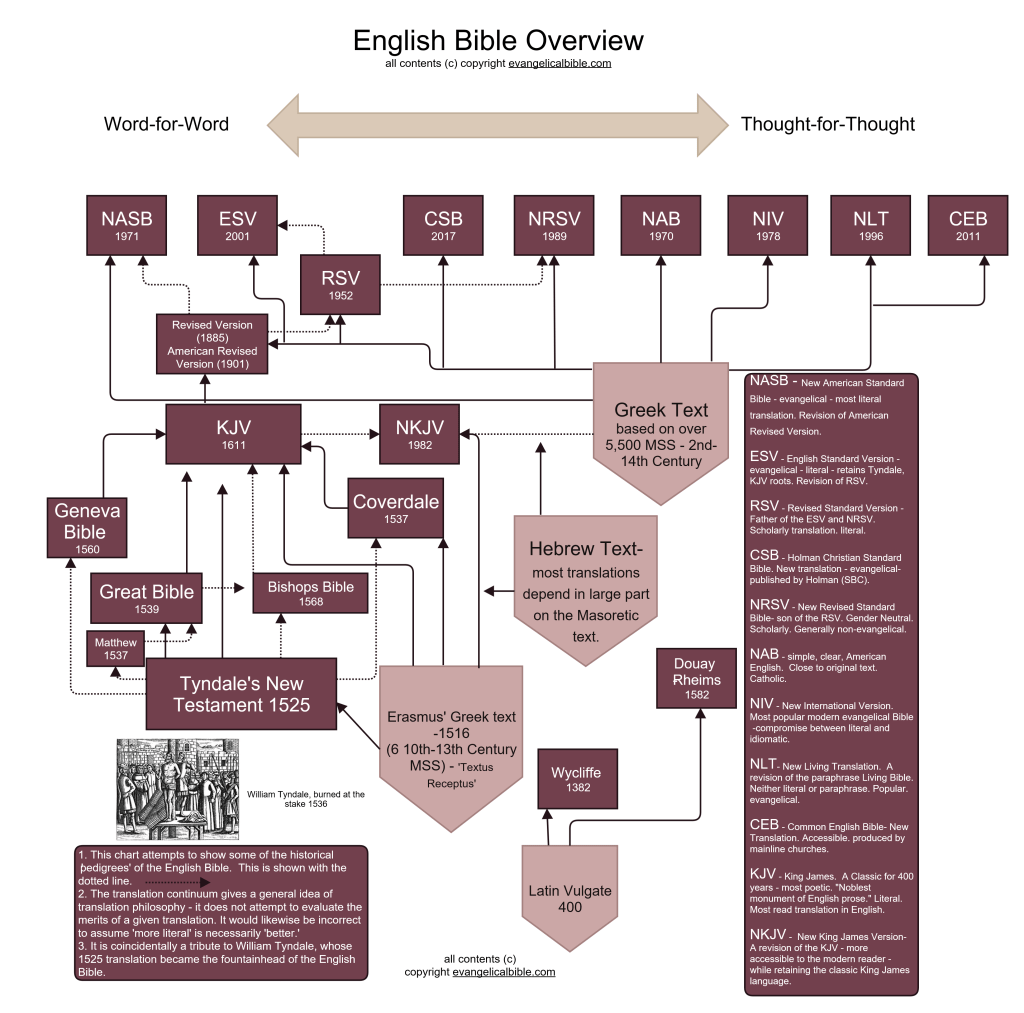
As you can see in the image for this article, even within one language there can be many, many translations, since living/spoken languages are always changing. The integrity of the original language texts isn’t as much in flux as in times past, such that any major changes to our understanding of it will be rare in the future.
Some claim that one particular English translation, the King James (KJV), is the only one “authorized” by God for the English-speaking world (what about non-English?). This is a baseless claim, since there’s no record of God giving sanction to any one translation over another. Only the Septuagint (or LXX, the Greek Old Testament) was used by Jesus, so that’s the closest anyone can come to a divinely-authorized translation.
Given all of that, what remains for us to decide is what’s best, not what’s ideal or perfect. So we may have a translation we prefer for general reading, another for memorization, and still another (better, several) for deeper study. Bibles from different publishers and translation teams will minimize bias, though never eliminate it.




 Bible U